


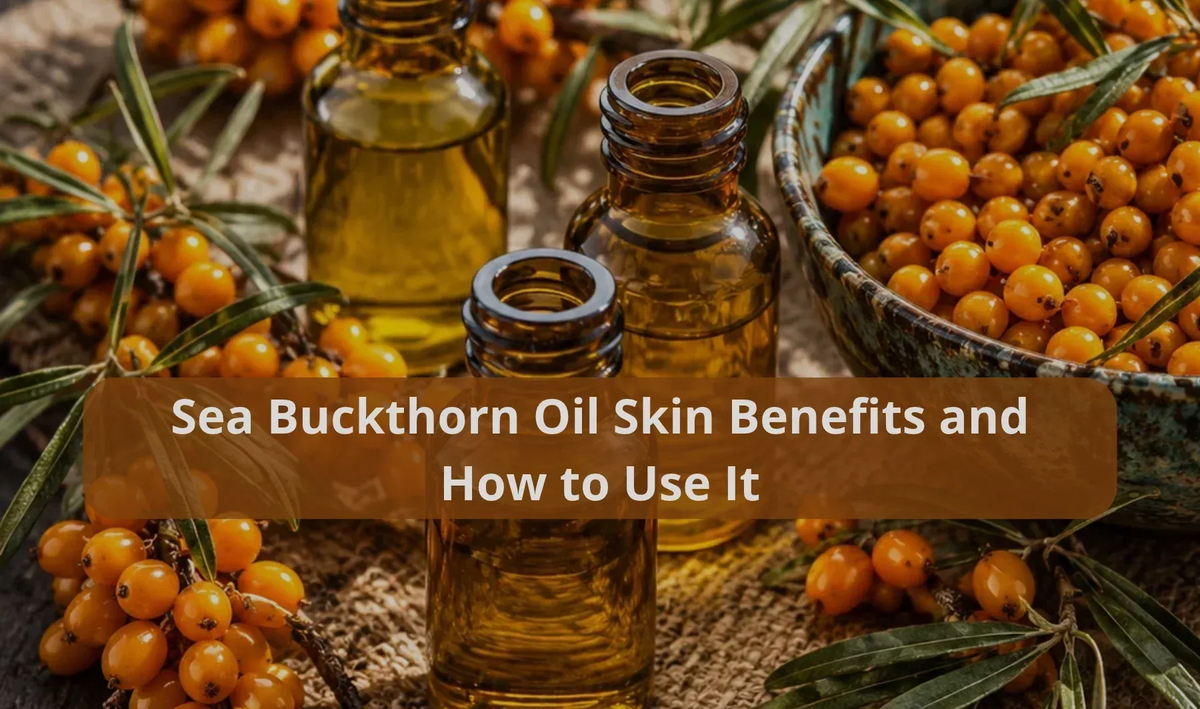
Wondering if sea buckthorn oil is right for your skin? Learn about sea buckthorn oil skin benefits, including softer skin, moisture retention, and antioxidant properties. This guide also explains how to use it, possible side effects, and what to consider before adding it to your skincare routine.
The key sea buckthorn oil skin benefits include softer skin, improved moisture retention, and antioxidant protection from its fatty acids, carotenoids, and vitamin E. However, results depend on the formula and your skin type, and it is not a proven treatment for wrinkles, acne, or dark spots.
This guide covers how to use sea buckthorn oil for face care, side effects, and label-reading tips without the hype.
What Is Sea Buckthorn Oil?
Curious about that bright orange oil appearing in your skincare searches? You are not alone
Sea buckthorn oil comes from the seeds or fruit pulp of the sea buckthorn plant, also called Hippophae rhamnoides. Despite its name, this shrub grows on land. Its orange berries are the starting point for several different ingredients.
Wondering what sea buckthorn oil is doing in your moisturiser? Sea buckthorn skin care includes facial oils, creams, balms, and other products. However, an oil, a fruit extract, and a juice are different preparations. They should not be treated as interchangeable simply because they come from the same plant.

Understanding Hippophaes Benefits for Skin
If you are exploring hippophaes benefits, start with what you want from your skincare: softer-feeling skin and better moisture retention are more realistic goals than a promise of flawless skin. Hippophae is the botanical name behind sea buckthorn. Its seed and berry oils have different compositions, so the benefits depend on which ingredient is used and how the product is made. When comparing hippophaes benefits, choose research about topical skincare rather than assuming that results from supplements also apply to your face.
Sea Buckthorn Seed Oil vs Berry Oil
Seed oil and berry, or pulp, oil have different fatty-acid profiles. An original study comparing sea buckthorn oils found that seed oil was rich in linoleic and alpha-linolenic acids, while palmitoleic acid was concentrated in the softer fruit parts.
| Feature | Seed oil | Berry or pulp oil |
|---|---|---|
| Source | Seeds inside the fruit | Fleshy parts of the fruit |
| Fatty-acid emphasis | Linoleic and alpha-linolenic acids | More palmitoleic acid than seed oil |
| Color | Can be lighter than pulp oil | Often strongly orange or reddish |
| Buying consideration | Check which plant part is named | Check color and intended use |
These variations matter when comparing hippophaes benefits, but they do not rank quality. Mixing, processing, and variety can alter the finished product. A darker hue does not guarantee that an oil will benefit your skin more.
Key Sea Buckthorn Oil Skin Benefits
When exploring sea buckthorn oil skin benefits, the most useful starting point is everyday skin comfort. Before making bold claims, consider softness and moisture retention. Research is fascinating, but extensive studies on people who use face cosmetics have not yet validated every suggested benefit.
Helps Soften Dry, Rough Skin
Oils function as emollients, which are substances that make skin feel smoother and softer. For this reason, when your cheeks feel scratchy, or you want a little extra comfort from your regular regimen, a face oil may be tempting.
A study of a sea buckthorn oil emulsion tested skin hydration in healthy volunteers and reported a moisturising effect. The researchers used a specific emulsion containing about 40% sea buckthorn oil.
This finding helps explain interest in sea buckthorn oil skin care benefits, but it does not prove that all products work the same way.
The formula's structure and additional additives are also important.
Reduces Moisture Loss
Your skin needs both water and the right ratio of lipids, or fats. A face oil alone cannot deliver the water that a water-based moisturiser provides, but it can support moisture retention.
The research review on sea buckthorn oil composition discusses how vegetable oils can form a surface film that reduces water loss. This helps explain their role in moisturising formulas.
More oil might not be the solution if your face still feels constricted under an oily finish. Instead of constantly adding another layer, ask yourself whether your overall moisturising routine meets your needs.
Includes Antioxidant Substances
Sea buckthorn oils can contain compounds such as carotenoids and tocopherols. Their amounts vary with the plant material and processing. The same composition review describes these components and their relevance to cosmetic use.
Research on antioxidant activity helps, but it does not guarantee that a product will visibly slow ageing. A laboratory result cannot predict how your face will look after you use a specific bottle.
Also, keep oil composition and berry nutrition separate. Do not turn a claim about vitamins in whole berries into a claim about a face oil until researchers evaluate the oil itself.
Possible Calming Advantages
A 2025 review of sea buckthorn and skin health explores possible anti-inflammatory effects and barrier-related mechanisms. Much of the discussion involves laboratory or animal research rather than everyday facial use in people.
This makes soothing benefits an area of interest, not a reason to replace treatment for a skin condition. If you have persistent redness, irritation, or discomfort, seek advice tailored to your skin type.
When you read about sea buckthorn oil skin care benefits, look for explanations of the research type. "This product has been shown to do this" and "researchers are exploring this" have different meanings.

What About Acne, Fine Lines, and Dark Spots?
These are reasonable enquiries while looking into the BENEFITS of sea buckthorn oil for skin. Skincare descriptions sometimes outpace the evidence. No study has demonstrated that a softer-feeling product can remove pigmentation or treat acne.
For fine lines, separate long-term wrinkle reduction from a smoother-looking moisturised surface. For dark spots, look for studies that measure pigmentation instead of relying on a broad antioxidant claim.
Acne needs the same careful approach. Do not present findings about a plant extract or specialised cream as proof that pure sea buckthorn oil clears acne.
Your experience also depends on the complete product.
Use this simple guide when judging claims about sea buckthorn oil skin care benefits:
| Evidence described | What it can tell you | What it cannot establish alone |
|---|---|---|
| Oil composition analysis | Which compounds were measured | Visible results on your face |
| Laboratory or animal experiment | Possible biological effects | The same benefit in people |
| Human topical study | Results for the tested formula | Results for every face oil |
| Oral supplement study | Effects of taking that supplement | Effects of applying oil |
The 2025 review highlights the need for stronger clinical research. A balanced routine can include a face oil without expecting it to solve every skin concern.
Sea Buckthorn Oil vs Rosehip Oil vs Argan Oil
Are you thinking about using sea buckthorn oil in addition to rosehip or argan for facial care? There isn't a single winner. These oils come from different plants and have different compositions.
The more useful question is which finished product fits your preferences and routine
A review of botanical oils explains why their fatty-acid profiles and other components matter. It also shows why “plant oil” is too broad a category to predict performance.
| Factor | Sea buckthorn oil | Rosehip oil | Argan oil |
|---|---|---|---|
| Plant source | Sea buckthorn seeds or fruit pulp | Rose fruit, often its seeds | Argan kernels |
| Composition to consider | Seed and pulp oils differ substantially | Often rich in polyunsaturated fatty acids | Oleic and linoleic acids are important components |
| Main shopping question | Which plant part is used? | What oil and blend are listed? | Is it intended for facial use? |
| Texture | Assess the finished formula | Assess the finished formula | Assess the finished formula |
| Best choice | Depends on your needs and tolerance | Depends on your needs and tolerance | Depends on your needs and tolerance |
Rather than choosing by a fixed pore-clogging score, read the full ingredient list and product directions. A blend containing several oils may feel very different from a single ingredient sold on its own.
Price is another reason to compare actual products. Check the cost per millilitre, bottle size, and what you are receiving. A higher price or a longer ingredient list does not, by itself, show better results.
How to Use Sea Buckthorn Oil for Face Care
Choose a product made for facial use and follow its instructions. No single quantity or dilution works for all sea buckthorn oils especially when brands market concentrated substances and pre-made blends under identical names
Determine your needs before selecting sea buckthorn oil for face care. Are you searching for a face oil that complements your evening regimen, a softer finish, or additional comfort after moisturiser? A single, well-defined goal makes your decision easier to evaluate.
Before applying it widely, follow the American Academy of Dermatology’s product-testing guidance. It recommends testing on small areas, using the normal amount twice daily for seven to ten days.
For regular use, keep the process simple:
- Cleanse gently and follow your established skincare routine.
- Apply the face oil where its instructions place it in that routine.
- Use the recommended amount rather than adding more for faster results.
- Notice how your skin feels and whether the product causes unwanted changes.
Consider introducing one new product at a time. This makes it easier to identify what you enjoy and what you might need to stop using. You do not need to replace every step just to try one ingredient.
Using Sea Buckthorn Oil for Face Care at Night
A leave-on facial oil can fit into an evening routine when its directions allow it. Check the label first; do not assume that every concentrated oil is ready to apply directly overnight.
For example, Céleste Switala describes Naked Glow Brightening Face Oil as a finishing step. It is a multi-ingredient blend containing sea buckthorn, so it should be understood as a complete formula rather than pure sea buckthorn oil.
Keep a quick note of the product, amount, and any changes you notice. This is more useful than expecting a specific result by morning. Stop if you develop irritation rather than treating discomfort as a sign that the oil is working.
Adjusting Your Routine in Summer and Winter
Seasonal changes can affect how you enjoy sea buckthorn oil skin care benefits. Let your skin guide adjustments to your routine. The AAD’s winter skincare advice discusses adjusting moisturising care in colder conditions. An oil may be an optional part of that routine, not its entire foundation.
In warmer weather, reassess whether you enjoy the same texture and amount. You might prefer a lighter-feeling formula or reserve an optional oil for evenings. There is no special summer dose that everyone needs.
Keep sun protection separate. The AAD recommends broad-spectrum, water-resistant sunscreen with SPF 30 or higher. Sea buckthorn oil is not a substitute, and mixing oil into sunscreen is not a shortcut to a better routine.

Possible Side Effects of Sea Buckthorn Oil and Precautions
When researching side effects sea buckthorn users often report, remember that natural ingredients can still be unsuitable for an individual. Consider the entire formula, including added scent ingredients, rather than assuming a reaction must come from sea buckthorn itself
Redness, itching, and swelling can signal a reaction to a skincare product. The AAD advises washing off a product that causes a reaction and stopping its use. Seek medical help for a severe reaction or symptoms that do not settle.
Colour is a separate consideration. Concentrated, strongly coloured oil may leave a temporary tint or transfer to fabric. The topical emulsion research identifies the oil’s strong colour as a formulation challenge. This does not mean every finished product will stain equally.
If you are researching “side effects sea buckthorn,” check whether the information concerns supplements or skincare. Swallowing an oil and applying a cosmetic are different uses. Their doses, exposure, and precautions should not be mixed together.
5 Common Sea Buckthorn Oil Myths Explained
Myth 1: Every Product Will Turn Your Face Orange
The oil’s colour deserves attention, but a concentrated ingredient and a blended facial product are different. Check the actual formula and application directions instead of judging every bottle by a photo of pure oil.
Myth 2: Oily Skin Should Never Use Moisturising Products
Oily skin still needs appropriate care. The AAD’s moisturiser guide discusses choosing products for different skin types. This does not mean every oily complexion needs a face oil; make it an optional choice based on suitability.
Myth 3: Seed Oil and Berry Oil Are Identical
They come from the same plant, but their compositions differ. Ask which part is used if the description is unclear. This is more informative than assuming all sea buckthorn products offer exactly the same ingredients.
Myth 4: Pure Oil Is Always Better Than a Blend
Purity describes what is in a bottle, not whether it is the best choice for your face. A finished blend can be designed around application and texture. Judge it by its purpose, directions, and your experience.
Myth 5: Natural Means No Need to Test
A search for “side effects sea buckthorn” is a useful reminder to look beyond the word natural: plant origin does not guarantee that your skin will agree with a product. Treat a botanical formula with the same attention as any new skincare purchase, even if you have used some of its ingredients before.
How to Read the Label and Choose Sea Buckthorn Skin Care
Understanding sea buckthorn oil skin benefits is only part of choosing a product. Shopping for the right sea buckthorn skin care product becomes easier when you know what to check. Before adding another bottle to your shelf, work through these five points.
1. Identify the Plant Part
Look for seed oil, fruit oil, pulp oil, or a clearly described blend. If the label only says sea buckthorn oil, ask the brand for clarification rather than guessing from the colour.
2. Check the Product Type
Ask yourself: what is sea buckthorn oil being sold as here a cosmetic ingredient for formulation, a finished facial oil, or an oral supplement? Choose a product made for your intended use. Similar names do not mean the instructions are interchangeable.
3. Put Extraction Claims in Context
You may see cold-pressed or CO₂-extracted on a label. Treat this as production information, not a complete quality score. Ask what plant part was processed and what information the brand provides about the resulting ingredient.
4. Read the Full Formula
When choosing sea buckthorn skin care, one highlighted ingredient is only part of the story. Check the other oils and scent ingredients, particularly if you already know that certain products bother your skin. Avoid choosing solely because sea buckthorn appears on the front label.
When exploring botanical face oils, compare the stated purpose and directions of each formula. Choose the one that answers your own needs rather than the one making the longest list of promises.
5. Check Storage and Use Information
Look for storage instructions, expiry information, and the period-after-opening symbol where provided. Choose a size you expect to use within that period. If instructions are missing or unclear, contact the brand before buying.
Frequently Asked Questions
What Are the Negative Side Effects of Sea Buckthorn Oil?
Irritation, an individual reaction, and transient colour transfer from highly pigmented formulae are potential issues with topical treatments. Another component of the mixture may be involved in a reaction. If a new product starts to induce symptoms, discontinue using it. Precautions for oral supplements are distinct from recommendations for facial skincare.
Is Sea Buckthorn Good for Wrinkles?
Although it can be used as part of a moisturising regimen, there is currently no proof that all sea buckthorn face oils minimise wrinkles. Different results include softer-feeling skin and long-lasting wrinkle reduction. Before you trust certain anti-aging claims, look for human research on the final product.
How Long Does Sea Buckthorn Oil Take to Work?
There isn't a trustworthy timeline that works for every formula or issue. Evaluate skin comfort independently of pigmentation or line changes. Steer clear of guarantees of results within a certain time frame. Don't continue using a product if it bothers your skin in order to meet a deadline
How to Use Sea Buckthorn Oil on Face Overnight?
Select a face-use leave-on product, test it beforehand, and adhere to the recommended dosage and stacking guidelines. Don't use a concentrated substance as a nighttime remedy. Ask your clinician how an extra product fits into your current skincare regimen if you already use prescription skincare products.
What Does Sea Buckthorn Do to Your Face?
Sea buckthorn oil skin benefits in a suitable formula can include softer skin and moisture retention. It is especially intriguing for studies on antioxidants and relaxation due to its makeup. It is an optional skincare ingredient, and how well your skin handles it, your current routine, and the entire mix will determine the outcome.
About the Author
Celeste Switala is the founder of Celeste Switala Skincare,
focused on honest, evidence-informed botanical skincare.
Learn more about her approach in the About Celeste Switala
Sources & References
https://www.aad.org/public/everyday-care/skin-care-secrets/prevent-skin-problems/test-skin-care-products
https://pmc.ncbi.nlm.nih.gov/articles/PMC12644098/